Today, the way congregants engage with giving expands beyond physical currency. Traditional methods like passing the plate remain a sacred part of many services, yet they represent only a small fraction of a household’s true giving potential.
Modernizing your church’s giving program helps meet your members where they are, through the digital and financial tools they use daily. By diversifying your giving options, you remove the friction that often prevents someone’s desire to respond from becoming a tangible act of worship.
Evolving to include modern giving methods allows your ministry to grow giving and tap into wealth that goes much deeper than the cash people have in their pockets on Sunday morning. Through a few thoughtful changes, your church can foster a more inclusive and sustainable culture of generosity among its congregation.
Encourage planned gifts.
While many church leaders focus on immediate stewardship, planned (or legacy) giving offers a way to secure the church’s mission for future generations. Many members want to leave a lasting impact on their faith community but are unsure of how to do so. By introducing legacy giving, you help members see their estate as a final opportunity for stewardship.
There are several types of planned gifts to consider, such as:
- Charitable bequests: This is the most popular planned gift, where a donor leaves a specific amount, a percentage, or the remainder of their estate to the church in their will or trust.
- Living trusts: These allow donors to avoid probate by placing assets in a trust and naming the church as a beneficiary for specific assets or funds.
- Beneficiary designations: Donors name the church as a beneficiary of their life insurance policies or retirement assets (such as an IRA or 401k).
- Charitable gift annuities (CGAs): A CGA is a contract in which a donor contributes cash or securities to your church in exchange for fixed income payments for life.
To launch a formal program, start by investing in accessible estate planning tools. For instance, providing a free online tool to help members create their wills makes it easier for them to include your church in their future plans.
Teach your church members about planned giving.
Educating your congregation about legacy gifts helps members view donating their estate as a final act of stewardship. By integrating these conversations into your regular church communications, you normalize the topic and make it accessible for everyone.
To create a well-rounded marketing strategy, FreeWill recommends including the following elements in your plan:
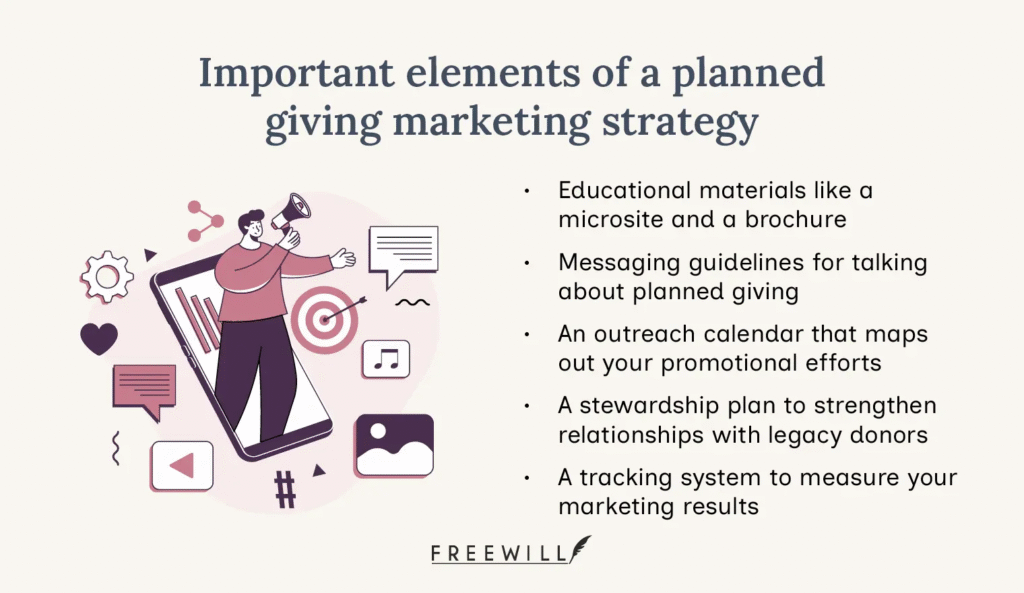
- Educational materials, including a dedicated website page, microsite, and brochure
- A messaging guide with templates and guidelines for talking about planned giving empathetically
- An outreach calendar that maps out planned giving promotional efforts
- A stewardship plan to strengthen relationships with legacy donors, such as by creating a legacy society
- A tracking system to measure the impact of your marketing
Having open conversations helps integrate legacy giving into your church’s culture, which ensures members see how their future gifts sustain the church’s long-term mission and budget. By being consistent and empathetic in your outreach, you provide your members with the clarity they need to make meaningful, long-term decisions.
Provide digital giving options.
When a member feels a spiritual call to give but doesn’t have their checkbook or cash on hand, the absence of a digital option creates a barrier. Today, two-thirds of churches report receiving a majority of donations through digital platforms.
Online giving options ensure that every member can contribute, whether they’re physically present or attending a live stream of your service. As Double the Donation’s church fundraising guide explains, this convenience empowers your church to “just as easily accept offerings on a Tuesday night as you could on a Sunday morning.”
When you invest in an online giving platform, be sure it’s mobile-responsive so your members and guests can give whenever and wherever they feel moved. Provide a variety of digital giving options, including:
- Credit and debit card donations
- ACH direct deposit
- Digital wallet integrations like Apple Pay and Google Pay
- Text-to-tithe for quick donations via smartphone
- Recurring donations to encourage tithing and consistent support
These options help congregants practice stewardship in ways that align with their daily financial habits.
Normalize digital offerings during service.
Integrating digital options into your liturgy ensures that technology serves the worship experience rather than distracting from it. By explicitly mentioning digital giving during the service, you signal that these tools are a valid and valued part of stewardship. This practice bridges the gap between tradition and the modern needs of your community.
Here are a few strategies for normalizing digital stewardship in the sanctuary:
- Reference and encourage online options during the traditional offering time.
- Display QR codes on screens during transitions or in your bulletin.
- Include a physical card in the pew for digital givers to place in the plate as an act of worship.
These simple adjustments transform the offering into a unified moment of stewardship that welcomes everyone regardless of how they choose to give. When digital giving is treated with the same reverence as the passing of the plate, it reinforces the idea that the heart behind the gift matters far more than the medium used to send it.
Accept non-cash gifts.
Most churches primarily request cash donations, but to truly modernize, your church should accept non-cash assets like cryptocurrency and stocks. After all, a study of one million nonprofit tax returns found that in a five-year period:
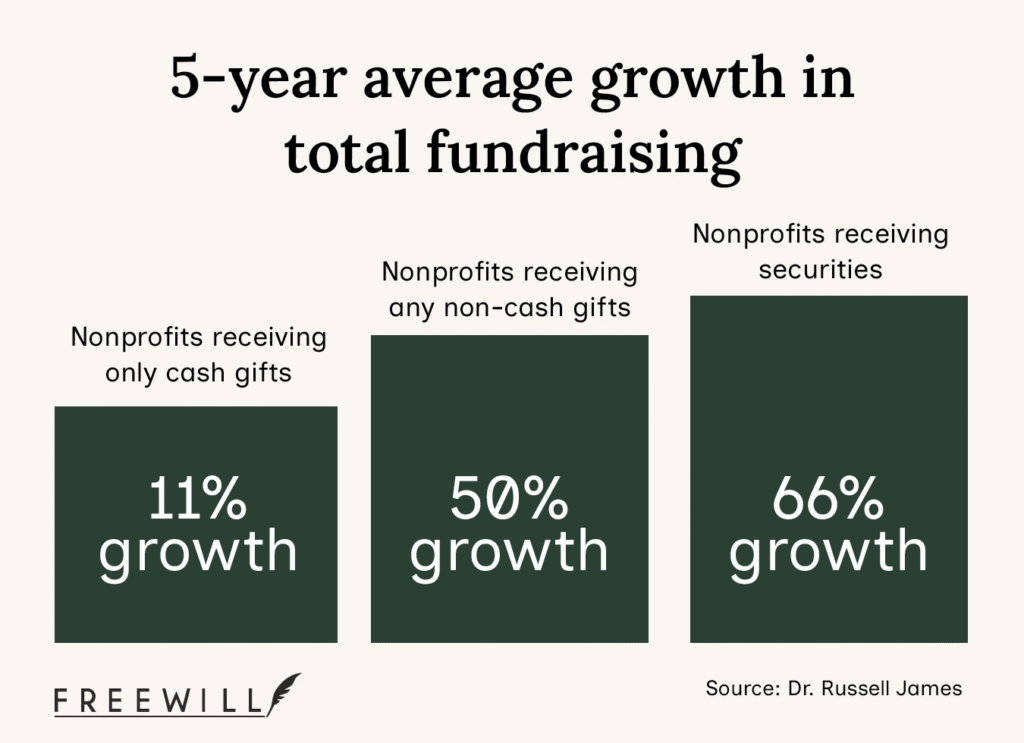
- Organizations that strictly accept cash donations grew by 11%.
- Nonprofits receiving any non-cash gifts grew by 50%.
- Organizations that accept appreciated securities (like stock) grew by 66%.
Providing options for non-cash giving is a powerful way to practice stewardship education while increasing your church’s financial stability. Consider these options:
- Appreciated stocks and bonds: Donating stock that has increased in value allows the donor to avoid capital gains taxes while receiving a full fair-market value tax deduction.
- Donor-advised funds (DAFs): These are the fastest-growing giving vehicles in the U.S., allowing donors to make a charitable contribution and then recommend grants to the church over time.
- Qualified charitable distributions (QCDs): Members aged 70.5 or older can give directly from their IRA to your church, which satisfies their required minimum distribution without increasing their taxable income.